Before I continue my blogs on the Budapest I am going to briefly mention the Fajarowicz Gambit - an off-shoot of the Budapest Gambit (and not one I am brave enough to play).
History
The first known recorded game of the Fajarowicz Gambit (or Fajarowicz-Richter System) was between Herman Steiner and Sammi Fajarowicz (chapter 8, game #) in Wiesbaden, 1928.
The result of the game was a loss for the German Champion, Fajarowicz, though a promising position had been reached. It is worth noting that Fajarowicz died at the age of 32 and the theory progressed through Kurt Richter, a German International Master, who preferred this line to the standard Budapest Gambit.
Over the years the opening has declined in popularity, as the complex and dynamic theory behind the opening has not been studied deeply enough for continuous play by any one Grandmaster. Though, the opening has been employed at the highest level in recent years by Grandmasters more as a surprise defence or attack!
The Initial Position
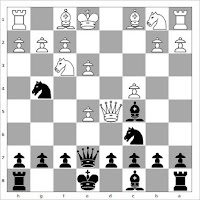
The opening of the FG begins when the following position arises:
 This is most commonly reached through the moves 1.d4 Nf6 2.c4 e5 3.dxe5 Ne4.
It is worth examining this position to see the relative merits of the position, as we did with the BG.
Firstly, we will look at this from White’s perspective.
 White has a good square for his Queen’s Knight on f3, tucked behind the pawn on f4 which he will be looking to support with the light-square Bishop. The Black Knight on e4 restricts White’s pawns from advancing. White will be looking to castle Kingside with this opening, though there is still development to be done before this. But most pressing is the Knight on e4 and whether to attack this piece or develop naturally. In the Queen’s Gambit white is expecting to exchange the pawn on the c-file rather than the centre pawn on the d-file and many players who choose the Queen’s Gambit for its slow development and safe lines can get into an uncomfortable position, even this early into the game.
Black’s analysis can be done in the same way.
 Black is looking to castle Kingside, though in many FG games the King castles Queenside to allow his Kingside pawns to advance up the board and help in the attack. Black seeks to get his Queen on the open file once the Bishop is out in the open. The Queen’s Knight develops naturally and d6 will open the lines for the Queen’s Bishop. The Pawn move d5 is usual in the FG to support the Knight on e4 and control central squares. The Knight on e4 is Black’s most aggressive piece and is hard to ignore.
It is early on and much can happen, but it is often useful to take 2 minutes at each step to see the overall plan and make sure that moves you make are both flexible and strategically sound. Connecting moves and ideas such as King Bishop out first to allow, castling, d5, Queen on the open file and Queen Bishop out allow plans to flow naturally.
It is now up to White to decide on whether to attack the Knight or develop naturally (best).
History
The first known recorded game of the Fajarowicz Gambit (or Fajarowicz-Richter System) was between Herman Steiner and Sammi Fajarowicz (chapter 8, game #) in Wiesbaden, 1928.
The result of the game was a loss for the German Champion, Fajarowicz, though a promising position had been reached. It is worth noting that Fajarowicz died at the age of 32 and the theory progressed through Kurt Richter, a German International Master, who preferred this line to the standard Budapest Gambit.
Over the years the opening has declined in popularity, as the complex and dynamic theory behind the opening has not been studied deeply enough for continuous play by any one Grandmaster. Though, the opening has been employed at the highest level in recent years by Grandmasters more as a surprise defence or attack!
The Initial Position
The opening of the FG begins when the following position arises:
This is most commonly reached through the moves 1.d4 Nf6 2.c4 e5 3.dxe5 Ne4.It is worth examining this position to see the relative merits of the position, as we did with the BG.
Firstly, we will look at this from White’s perspective.
White has a good square for his Queen’s Knight on f3, tucked behind the pawn on f4 which he will be looking to support with the light-square Bishop. The Black Knight on e4 restricts White’s pawns from advancing. White will be looking to castle Kingside with this opening, though there is still development to be done before this. But most pressing is the Knight on e4 and whether to attack this piece or develop naturally. In the Queen’s Gambit white is expecting to exchange the pawn on the c-file rather than the centre pawn on the d-file and many players who choose the Queen’s Gambit for its slow development and safe lines can get into an uncomfortable position, even this early into the game.Black’s analysis can be done in the same way.
Black is looking to castle Kingside, though in many FG games the King castles Queenside to allow his Kingside pawns to advance up the board and help in the attack. Black seeks to get his Queen on the open file once the Bishop is out in the open. The Queen’s Knight develops naturally and d6 will open the lines for the Queen’s Bishop. The Pawn move d5 is usual in the FG to support the Knight on e4 and control central squares. The Knight on e4 is Black’s most aggressive piece and is hard to ignore.It is early on and much can happen, but it is often useful to take 2 minutes at each step to see the overall plan and make sure that moves you make are both flexible and strategically sound. Connecting moves and ideas such as King Bishop out first to allow, castling, d5, Queen on the open file and Queen Bishop out allow plans to flow naturally.
It is now up to White to decide on whether to attack the Knight or develop naturally (best).
I'm going to leave the Fajarowicz there, whilst I have learnt more about this opening I think, at least at this stage, it is best not to "muddy the waters" with this line.






 Posts
Posts

