Showing posts with label Game. Show all posts

Wednesday, 26 November 2008

Howard Stern Playing the BG Declined

Q: What have Will Smith, Howard Stern, me and you got in common?

A: They all play chess!

In this blog I'm going to post one of "Shock-Jock" Stern's shorter games! He's quite a good player and has an ELO rating of 1600 - you can often catch him on the ICC. He's a great fan of gambits and especially the Budapest Gambit - one of my personal favourites).

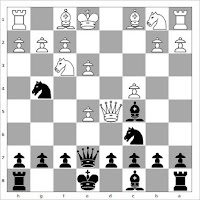
This is a BG declined with 3.d5. We've mainly looked at 3.Bg5, so far, but I'll be blogging more on the 3.d5 move next and this seems a nice way to introduce it.

Stern - Unknown
1.d4 Nf6 2.c4 e5 3.d5
Incorrectly White chooses to decline the Gambit. White gets his best game if he accepts with 3.dxe5.


3...Bc5
The strongest position for the Black bishop putting pressure on the f2 square.

4.h3?!
A terrible choice by White. Yes, this avoids 4...Ng4 there are other ways to attack the f2 square. 4.e3 or 4.Nc3 are stronger. Allowing Stern to go straight for the kill.

4...Bxf2+!


5.Kxf2
Best move, as 5.Kd2 leads to 5...Ne4+ and 6...Ng3 where either the Rook falls.

5...Nxe4+
In either case this is the best move.

6.Kf3
In a losing position White throws himself on the sword.

6... Qh4 7.g4 f5
Fritz says this in Stern's only move to keep the attack flowing, but it makes sense and not hard to find.


8.gxf5 Rf8 9.Ke3
White makes another positional mistake. 9.Nc3 would extend the agony!

9...Rxf5
Moving pieces in to the attack.

10.Nf3 Qf4+
Now comes the end.

11.Kd3 Nf2+ 0-1
White resigns. 12.Kc2 Qe4+ and the Queen falls.


I hope you enjoyed this game from a surprising player.

Thursday, 16 October 2008

Game 1 – Alder – Maróczy, 1896

Before I start delving into the strategy, motives and tactics of the Budapest Gambit I think a quick look at the Gambit's first ever game is in order. Oh, and it's a victory for the Gambit too!


Alder – Maróczy, Budapest, 1896

1.d4 Nf6 2.c4 e5 3.dxe5 Ng4 4.Nf3 Bc5 5.e3
The standard opening of the Budapest Gambit accepted with the Knight defence. This opening allows Black to place strong and immediate pressure on f2, forcing 5.e3 White’s only response (5.Nd4?? Nxf2! 6.Kxf2 Qh4+ 7.g3 Qxd4+ 8.Qxd4 [8.Ke1 Qf2+ 9.Kd2 b5 ] Bxd4+ or 5.Be3 Bxe3 6.fxe3 Nxe3 7.Qd3 Nxf1 )


5…Nc6 6.Qd5?!
Defending the pawn with the Queen is a bad idea here and better is 6.Be2 or Nc3 giving the pawn back, but relieving pressure.
6…Qe7
Attacking the pawn a third time, which now cannot be saved.


7.Nc3 Ngxe5 8.Be2
White is preparing to castle Kingside.
8…d6
Black is leaving the option open to castle either way and is opening the diagonal for his light-square Bishop.
9.Ne4?
This is a mistake by White. The attack on the Black Bishop is met by a counterattack with greater compulsion.
9…Be6
This move both develops the Bishop and attacks the Black Queen.


10.Qd1 Bb4+
(10.Qd1 or Qd2 [both equal] Bxc4 11.Nxc5 Bxe2 12.Nxe5 Qxe5 13.Qxe2 dxc5 Black has a pawn advantage, is better developed and an overwhelming attack on the Queenside).

11.Bd2 0-0-0
The Bxc4 capture is still viable on move 11, but Black chooses to castle and get his King safe an option which White doesn’t have time to take.

12.Bxb4 Nxb4 13.Qb3 Nxf3+ 14.Bxf3?
Almost inevitably the pressure becomes too much and White blunders. Here, 14.gxf3 d5! 15.a3 Nc6 is better.


14…d5! 15.Nd2 dxc4 16.Nxc4 Rd3
Removing the Knight’s defender.


17.Qa4 Bxc4 18.Qxa7??
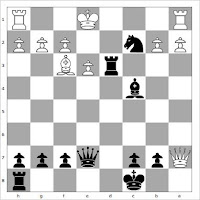
18.0-0 is best, but even this is delaying the inevitable. This leaves mate in two.
18…Nc2+
0-1
It is mate next move with either 19.Ke2 Rd5# or 19.Kf1 Rd1#


I hope you found this primitive game interesting. Many of the ideas of the Budapest Gambit are see in this game, though refined over time. It's always useful to have illustrative games to assist in opening theory.

Also, I do try to put a large number of boards in the blog, so that boards don't have to be used in reading these blogs, but it is good practice to have a board (physical or computer screen) to play through all the positions.